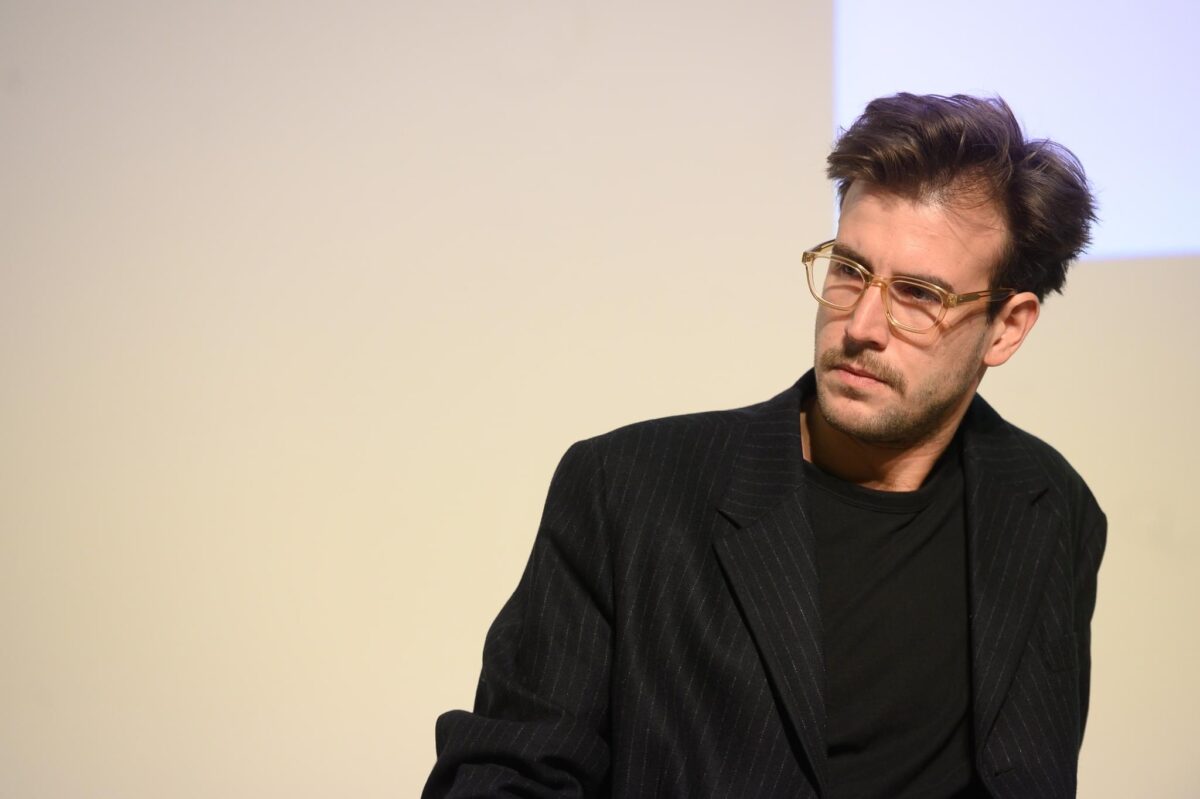

Andrea Szelesová is a Slovak director and animator. She created her first animated film Malady at the Václav Hollar Higher Vocational School, then continued her studies at FAMU, where she directed the films Mon Ami, the animated documentary 19 20 18, and the puppet film Afternoon Tea. She completed her studies with the film Sisters, which premiered in 2021 at the Annecy International Animation Film Festival. The film was screened at more than 60 festivals in 30 countries and won several awards, including Best Slovak Short Animated Film at the Fest Anča International Animation Festival. As an animator, she worked on Michaela Pavlátová’s feature film My Sunny Maad and on the television series Čtyřlístek and Rychlé šípy. We spoke with Andrea Szelesová on the occasion of the world premiere of her latest film Eeny, Meeny, Miny, Moe! in the Generation Kplus competition section at the 76th Berlinale.
The film Eeny, Meeny, Miny, Moe! is visually rich and full of dynamic action, especially in the scenes set in the “kindergarten” on Greek Mount Olympus. When telling the story of the main character Yios, the son of the Greek god Helios, how did you think about making it understandable even for the youngest audiences?
The script went through a fairly long development process, first in consultation with dramaturg Štepánka Ansorge and psychologist Petra Hackerová, and later through detailed work within the CEE Animation Workshop. As with my previous film Sisters, I aimed to make the film work on several levels, so that each viewer could understand it in their own way. I believe the core of the film – Yios’s exclusion from the group and his persistent effort to become part of it – is simple and readable. This is supported by clear emotions, the visual depiction of Yios’s glow (the barrier between him and the other children), and by recurring situations in which Yios fails to achieve his goal.
On another level, fans of Greek mythology will certainly discover references to various myths, while for younger viewers we chose main characters that are visually strong – for example Medusa or the Cyclops.
More subtle plot details tend to remain in the subconscious. Thanks to a new friend from Earth, Yios discovers that gentle touch helps him regulate his explosive emotions. However, he does not magically “heal” from his otherness. His glow explodes again at the end of the film, but now he knows how to help himself in such a situation. These details are important to me because they shift a narrative that I see as stereotypical in children’s films.
As a small anecdote at the end, I would add that our youngest test audience member is the producer’s three-year-old daughter, who still enjoys singing the song from the film.
As you mention, the film draws visual inspiration from Greek mythology as well as Minoan frescoes. What appealed to you about the aesthetics of Greek civilization, and what was the initial impulse: the film’s theme itself or a fascination with this visuality?
When it comes to the question of whether the egg or the chicken came first, in our case Yios wins. He was born in my head simply as a lonely little boy with a sun on his head, and only gradually did his story, his mythological origin, and the visual world surrounding him naturally attach themselves to him.
Minoan art had already fascinated me during my early years of studying art, even before I turned to animation. It contains a certain vitality – both in its forms and in its rich color palette, which seems made for animation. I was also drawn to its ornamental quality, since I often can’t resist ornamentation in my own work. The opportunity to play with almost flat graphic visuality while not breaking the illusion of life is, in my view, one of the strengths of animated film.
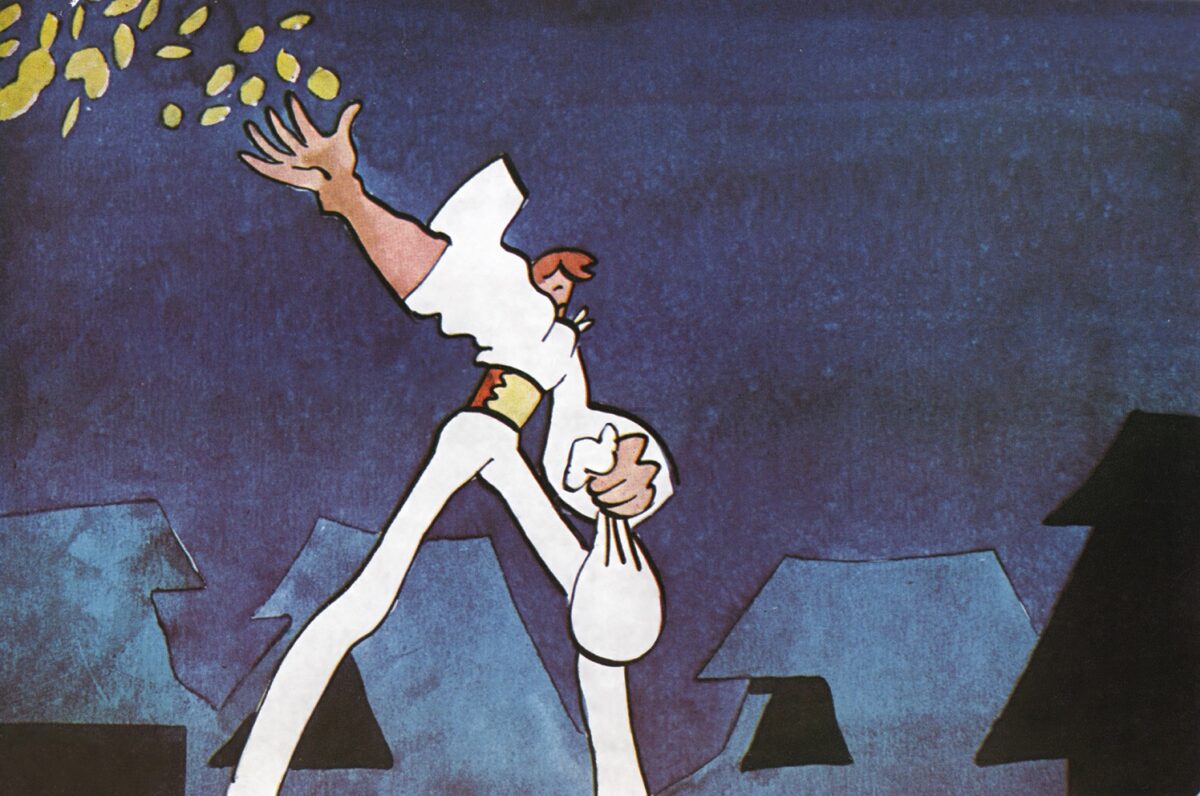
As another inspiration, I would mention Marcell Jankovics’s 1981 film Son of the White Mare, which the producer and I were lucky enough to see on the big screen at the Annecy festival. It processes mythology in a unique, evocative, atmospheric, and graphically powerful way that can at times almost overwhelm the senses, but certainly offers an unforgettable experience.
After the short animated film Sisters (2021), this is already your second collaboration with producer Kristina Husová (Pure Shore, Cinepoint). How would you describe your process of establishing a shared vision?
Kristina and I have a lot in common in our approach to work – our thoroughness can sometimes be almost comical, and our desire to give our very best is (unfortunately? or fortunately?) insatiable.
We find trust in each other, and with this film, which was the first professional animated film for both of us after graduating, we shared not only creative and dramaturgical decisions but also production responsibility. I think we both strive to create quality films with depth and meaning, without trying to follow trends or currents, and above all films that are sincerely sensitive.
Could you describe the 2D animation technique you chose and explain how the collaboration with the animation team worked when translating your directorial vision into the film’s final form?
The animation technique is largely hand-drawn animation created in a vector-based program, which also allows the use of simple cut-out animation elements. This enabled us, for example, to shift elements such as heads or Yios’s glow in moments when redrawing was unnecessary. However, we “balanced out” this efficiency with various complications, such as using differently colored outlines.
Specific for the film are also animated textures and semi-transparent outlines, which I had already developed as a personal technique in my previous films. Texture animation helps keep the characters alive, and the transparency of the lines creates an interesting “painted” effect that evokes brushstrokes on ceramics or frescoes.
Paradoxically, we often had to restrain the animation team, since the movement style is more restrained and less rubbery than, for example, classic Disney 2D animation. The team consisted of Slovak and Czech animators, and the collaboration took place entirely online, but in a spirit of constant communication and close individual cooperation with each animator.
The above mentioned film Sisters had a successful festival run after its world premiere in 2021 at Annecy. It seems that Eeny, Meeny, Miny, Moe! may follow a similar path, with its festival life beginning in just a few days at Berlinale. What does participation in these prestigious events mean to you?
For me as a creator, the festival life of Sisters was crucial. After severe creative burnout during the completion of my studies, I experienced firsthand the fulfillment of the vision with which the film was made. Its main goal – and the way I defended its strongly allegorical story – was to create a film in which viewers could find reflections of their own lives. After screenings, audience members approached me and shared their personal stories that they saw reflected in the film. This created a direct connection with the audience on a level I could hardly have hoped for. Eeny, Meeny, Miny, Moe! now targets a child audience and opens another door. It will be a completely new experience, one I am very much looking forward to.
Festivals are also a unique space for meeting people from the industry, broadening one’s professional horizons, gaining inspiration or feedback. And above all, for short films they represent an irreplaceable and often the only space in which they can reach a wider audience.
Since our film is intended for children and contains no dialogue, it will be interesting to see which festivals and sections it will be selected for. In addition to festivals, this time we also want to focus on other spheres and platforms, such as television or cinema screenings in a programme with other films or as a short before a feature. The film is represented by the prestigious company Miyu Distribution, so I believe it is in good hands.
The interview was conducted by Barbara Nováková (National Cinematographic Centre of the SFI).

Eeny, Meeny, Miny, Moe!
Generation Kplus
Screenings:
February 18 | 9:30 | Zoo Palast 1 (world premiere)
February 19 | 10:00 | Zoo Palast 2
February 20 | 13:15 | Cubix 6
February 21 | 10:00 | Zoo Palast 2
February 22 | 15:45 | Filmtheater am Friedrichshain