
Miro Remo is one of the most celebrated Slovak documentary filmmakers of his generation. He has already captivated world festivals with his short student works (especially Cold Joint and Arsy-Versy), which were followed by four feature films: Comeback, This Is Not Me, At Full Throttle, and the latest Better Go Mad in the Wild, which premieres in the Crystal Globe Competition at the Karlovy Vary International Film Festival (July 4 – 12, 2025).
Your film is based on Aleš Palán’s successful book of the same title about loners living in the Šumava region in the southwest of the Czech Republic. What attracted you to the book and why did you choose the twins František and Ondřej from among its characters?
I was appealed by the book’s intimate immersion into the world of outsiders. I love nature and the world without people. Reading it felt like I was reading the script for my next film. It contained inspiring thoughts from people who decided to take a different path – unlike most of us, including me. And it was these outsiders who were able to formulate the most fundamental questions of life. I really didn’t expect that.
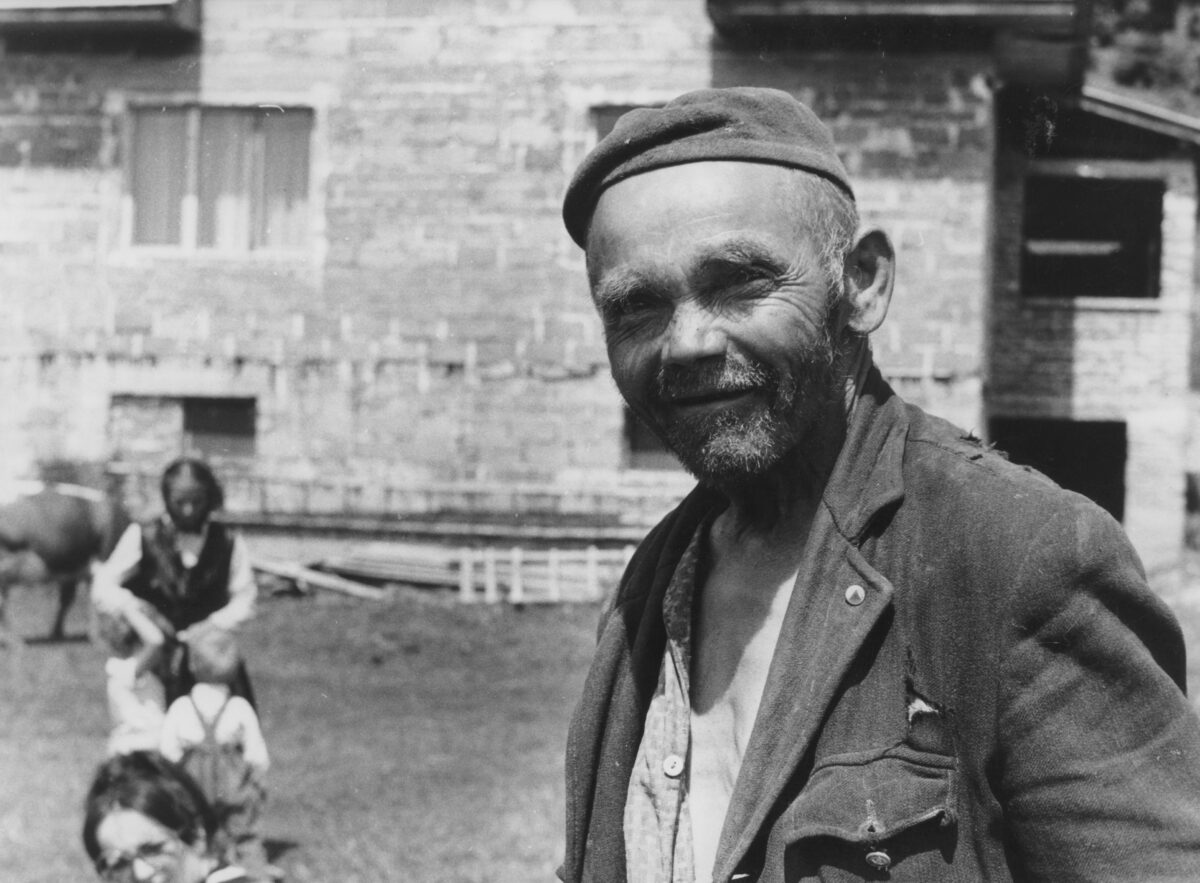
The twins caught my attention from the very beginning; they were my favourite characters. There was some concern in the creative team about whether it would be enough to follow only them – perhaps it stemmed from a lack of experience, but it also had a rational basis. After all, building an entire film on one story carries a risk. They are not young people, they like life and beer, one longs to fly, the other sometimes drowns in sadness. They are beautiful, but unpredictable. Anything can happen.
At the beginning, I worked with four characters: a philosopher and a womanizer Mirek Sedláček, a punk and a farmer Martina Kyselová, and the twins, František and Ondřej Klíšik. But fate intervened. Mirek and Martina died of cancer before I could make a final decision. So I stayed with the twins. In a documentary, sometimes life itself decides.
In the film, we see some kind of parallel world, completely cut off – seemingly, at least – from the surroundings. The twins also have their own dreams, for example, one of them has been trying to create a perpetuum mobile for years. What appealed to you about this world?
This feeling arises mainly from their environment: an old house that is aging with them. But it is not complete isolation. Their world is not fascinating because of whether or not they have technology, but because they are twins who live together and yet are so different. One retains his dreams – for example, the desire to build a perpetuum mobile. The other has his feet on the ground to such an extent that he seemingly does not even dream. They appealed to me with their loyalty to crazy, but also noble, human ideas in which they never stopped believing. No matter how unattainable they may be, they never stopped believing in ideals.
The film follows two characters, their animals, and the interactions between them; we don’t see any other people. Was it challenging to make a film in such a confined environment? Did you worry whether you would have enough material to film?
When I have enough time, I am not afraid that there won’t be enough material. I knew that they were strong and beautiful characters. My only concern was whether there would be trust and an intimate dialogue between us. I can’t film without that. Where passion is missing, there is no truth. And without the truth, the real beauty, there is no film.
The longer I was with them, the more I realized that nothing more was needed. If I had more time, maybe I would have delved even deeper into the relationships between their animals. But that would be a different film.
In the film you mainly use observation, seemingly not interfering with their world. But sometimes you insert formal playfulness into the film. How did you think about the formal techniques?
It is a form of play. I wanted to convey to the audience my experience of this extraordinary world. Franta and Ondra became my close friends; we say goodbye with a big hug. From the beginning, I felt a magical dimension in their story. It is hinted in the book, but in the film I gave it more space and at the same time deromanticized it.
They themselves managed to go beyond the ordinary and play with us. The moments you mention, such as a large mirror fished out of the Vltava River, reflect the magic and the split nature of their world, the duality. I wanted the film to feel like a fairy tale for adults. Adults play, too, only with different tools.
Similar to your previous films, we see several scenes with strong music – in this case, especially the symphonic poem Vltava by Bedřich Smetana. Why do you create these moments in your films? Do you think about the music while filming?
The Vltava River originates near their house, so the choice of music came quite naturally, after about twenty days of filming. Gradually, I liked the idea of using the entire My Fatherland (Má vlast) cycle more and more. Smetana’s music is so strong that it became another character in the film. I always choose music based on the image, never the other way around. I first need to feel what the image carries, only then can the sound come.
How did the narrator – the talking cow – get into the film?
The cow is magical. She is a character like any other. She often stands between them – literally and figuratively – watching them, commenting on their lives. And since this is a fairy tale for eternal children, the narrator had to be from their world.
At the same time, the cow brings another layer to the audience, for example when she explains how Franta lost both his hand and his fiancée. She adds intimacy and magic to the story. That is also why I chose her as the voice that accompanies us through this strange, moving, and peculiar world.
The interview was conducted by Tomáš Hudák (National Cinematographic Centre of the SFI).

Better Go Mad in the Wild
Crystal Globe Competition
Screenings:
July 10 | 8:30 | Congress Hall (Press & Industry)
July 10 | 17:00 | Grand Hall
July 11 | 10:00 | Pupp
July 12 | 08:30 | Congress Hall
July 12 | 17:15 | Lazne III