
Producer Rastislav Šesták is a graduate of Theatre Directing from the Academy of Performing Arts in Bratislava. In 2001, together with the director and producer Peter Bebjak, he founded D.N.A. Production, a production company he continues to lead to this day. His producing portfolio is broad and award-winning, encompassing fiction and documentary films as well as TV series across a variety of genres from dramas, historical and crime stories, to sci-fi and fairy tales. Ahead of the world premiere of the biographical feature film Duchoň at the Karlovy Vary IFF, his latest production, we spoke with Rastislav about the specifics of making a music-centered film and the approach taken in portraying an icon of the Slovak music scene – Karol Duchoň.
The film Duchoň, which you produced together with Peter Bebjak and which he also directed, is your first biographical feature film. What drew you to the character of Karol Duchoň, and how was this genre a new challenge for you as a producer?
I have wanted to produce a music film for a long time. I was looking for a topic and a performer whose story could carry the film or whose music could be the film’s foundation. During the brainstorming period, I met with several musicians, but something was always missing, it just was not the right fit. And then, all of a sudden, Duchoň started to appear more and more around us. We got a tip about a theater production in Martin about Duchoň’s life, we went to see it, and that was it. We had found what we were looking for.
This type of project is a real challenge from a producer’s point of view. I knew I would have to deal with copyrights and licensing, but I honestly did not expect it to be on such a scale. The rights to his songs had not been resolved in the past, so we had to sort all of them out. It took a lot of time and money. And, of course, I knew how the script was written, how many demanding scenes it contained, and that’s why I had to secure strong financial backing. That wasn’t easy at all.
The life of a music star can be portrayed in film in various ways. You and Bebjak chose to tell Duchoň’s story retrospectively, beginning in 1984, a year before his death, and focusing on key moments in his life and career. Why did you choose this narrative structure? Were there other approaches you considered and later abandoned during the development?
Our starting point was the aforementioned stage play The Earth Remembers (Zem pamätá). While it does not begin in 1984, it worked powerfully with the idea of pivotal and transformative life moments. We needed something strong right at the beginning, something not widely known, so we chose a real-life event that took place during the production of a New Year’s Eve TV program. Of course, we discussed various script approaches, but none of them felt compelling or attractive enough. Then the idea of the reverse narrative came up, and it gave us the ability to work interestingly with both the story and the music. I really liked the concept of the present interacting with the past. When the audience knows how it all ends, but experiences the confrontation with the past and expectations through the eyes of the main character. A powerful moment is when these two timelines eventually converge. It is also important that all the songs in the film are from the same period in which the given scene takes place.
The actor Vladislav Plevčík delivers a convincing performance across all phases of Duchoň’s life. Was it clear from the beginning that he would portray Duchoň?
Casting Duchoň in Slovakia was truly challenging for us, and we knew the audience would not forgive us easily, since we are making a film about a Slovak icon. Bebjak and I went through all the Slovak actors, and in the end, we chose Vladko. And I think we were very lucky with that decision.
You mentioned that dealing with music rights was challenging. How did the communication with the rights holders go?
This was probably the hardest part of the pre-production. Almost every song is owned by a different publisher, so we had to negotiate each one separately not only with the publisher, but also with the songwriters and the composers. It was really difficult to predict how each publishing house would respond. We had to explain to them multiple times what we were filming, what kind of scene it was, how many seconds of the music would be used, and so on. It was really a nightmare. (laughter)
The visual aspect of the film is striking – at times it resembles the aesthetics of a family archive, other times it draws from music video influences. The period costumes, makeup, and sets feel authentic and well-crafted. As a producer, were you involved in shaping the film’s visual style? How did the concept come together?
The entire concept was created by the director and the cinematographer. But I did manage to get a few of my own ideas into the film. (laughter)
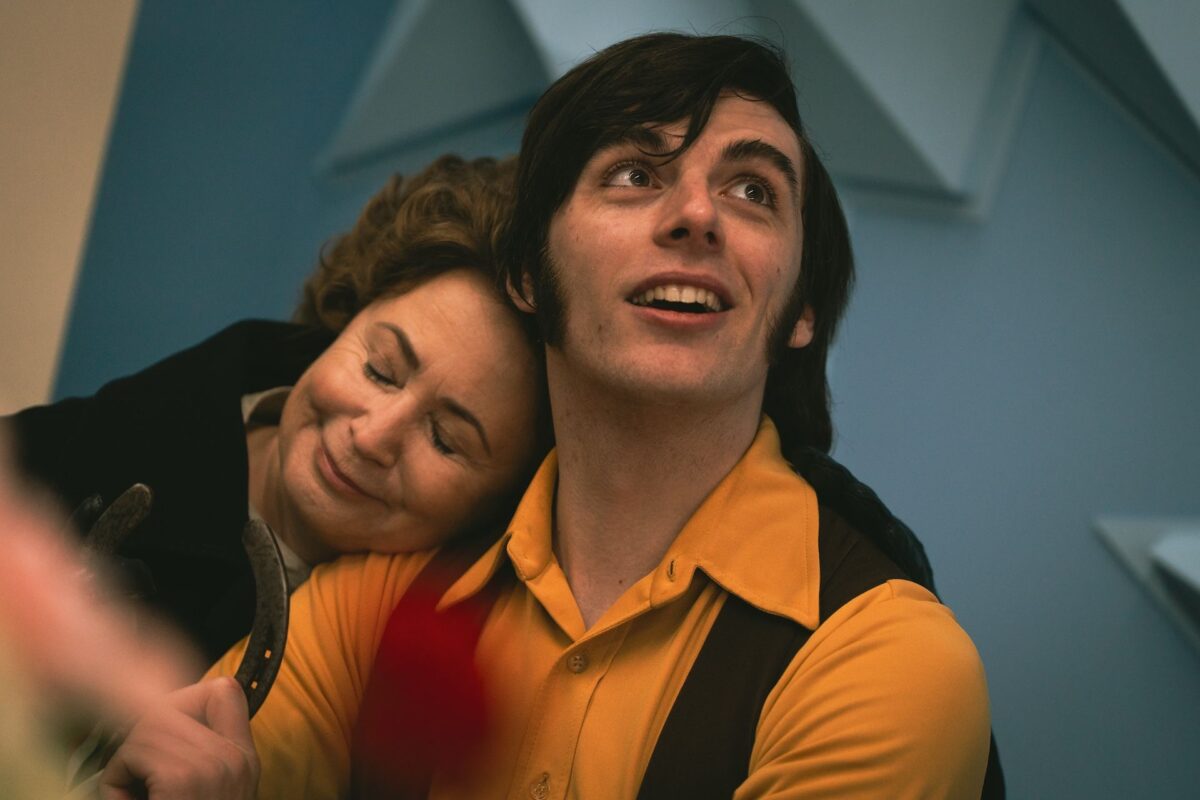
Together with colleagues such as Janko Kocman (costume designer), Juraj Kuchárek (production designer), Vlado Valovič (music supervisor), and Martin Jankovič (makeup), we paid great attention to accuracy and detail. We wanted the film to truly feel like it belonged to that era, full of extras, props, and atmosphere of the time. We aimed to create a film where the viewer feels transported to Duchoň’s time and nothing takes them out of it. As a producer, I wanted strong production value.
As part of the film’s promotion, you have introduced merchandise like T-shirts and you have shared quite an intensive behind-the-scenes look at the filming on social media, especially by local standards. How did this marketing approach come about?
Even before production starts, we know what we want to do in terms of PR and marketing – and we prepare for it in advance. We have a team dedicated solely to this. Of course, we would like to do much more, but we are limited by the financial realities of the market.
Duchoň will premiere at the 59th edition of the Karlovy Vary International Film Festival in the Special Screenings section. The film will then be released in Slovak cinemas on July 31. What are your plans for both domestic and international distribution? Do you believe the film can connect with audiences abroad who don’t have an emotional connection to Karol Duchoň’s songs?
We have a clear plan for the domestic market, with specific targets agreed upon with our distributor. As for the international audience, that is a big unknown. The film relies heavily on local emotion and a certain level of nostalgia, so we will see how these elements translate beyond Slovakia’s borders.
The interview was conducted by Barbara Nováková (National Cinematographic Centre of the SFI).

Duchoň
Special Screenings
Screenings:
July 6 | 17:30 | Cinema A (Press & Industry)
July 7 | 14:00 | Grand Hall (premiere)
July 8 | 20:00 | Pupp
July 10 | 22:00 | Congress Hall
July 12 | 10:00 | Karlovy Vary Theatre