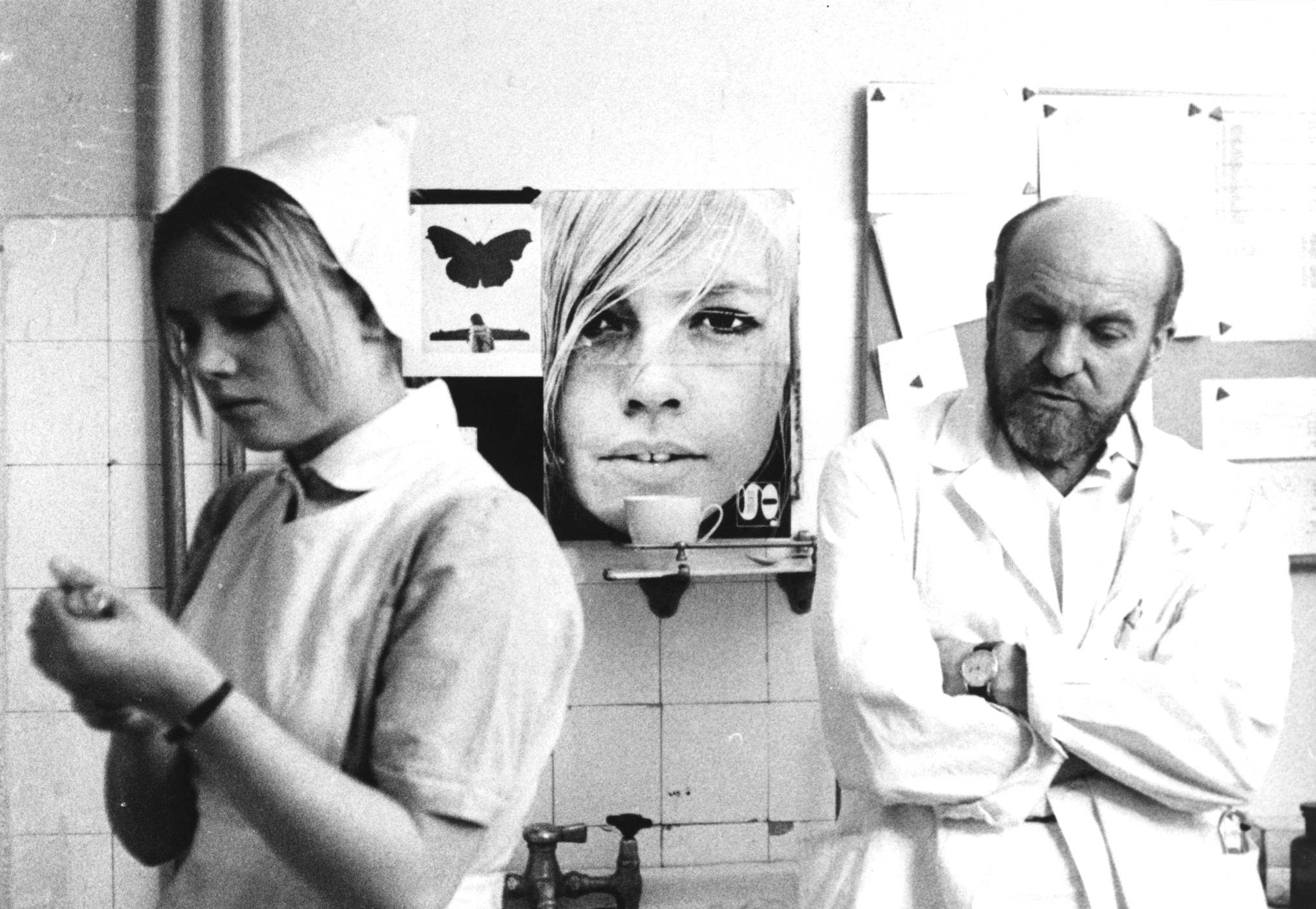
The feature debut 322 (1969) by director Dušan Hanák, awarded the Grand Prize at the Mannheim Film Festival and chosen by Slovak film critics and scholars as the Slovak Film of the Century in a 2021 Film.sk magazine poll, is being released these days on Blu-ray with an extensive booklet and bonus materials. The film is a key work of the Czechoslovak New Wave, which was kept in the vault during the period of normalization before finally reaching audiences after the Velvet Revolution.
322 is a psychological story about the illness of an individual and of society. Its central character, Jozef Lauko, reevaluates his life and worldview in fear of an incurable disease. He interprets his situation as punishment for his past deeds, but also as an opportunity to rid himself of guilt and cleanse his conscience. The film was inspired by Ján Johanides’s short story The Sources of Sea Attract the Diver. “Although the screenplay for Hanák’s film was created in collaboration with Johanides, 322 is more of a dialogue with the literary original than a direct adaptation,” explains film theorist and critic Katarína Mišíková in the Blu-ray booklet. “The film’s story relies primarily on the atmosphere of quiet anxiety and the character of the protagonist; beyond that, it borrows only a few motifs from the short story, significantly changes the narrative strategy and the hero’s name, and creates an entirely new plot. One could say it is a very loose film adaptation of the literary work.”
Dušan Hanák was the only director from the generation that debuted at the end of the 1960s who also had several years of experience as a documentarian, which was reflected in his work of fiction. Between 1967 and 1969, he paused his documentary projects to shoot his debut feature 322. “The literary character of the cook Lauko had no political background. I introduced the motif of the hero’s guilt, who had once participated in political purges and collectivization, and I was intrigued by the paradox that such a person could also be good… What guided me was my strong personal sense of the relativity of values. Moreover, at that time, it wasn’t considered appropriate for a young director’s film to have a communist as the main character. My colleagues from the ‘New Wave,’ like me, had different value criteria – we were focused on the authentic lives of ordinary people, and party officials didn’t belong among them,” Dušan Hanák reflected on the film in retrospect.
Alongside several non-professional actors and well-known figures from the streets of Bratislava, the film also included prominent Czech and Slovak actors, such as Václav Lohniský as Jozef Lauko, as well as Josef Abrhám, Miroslav Macháček, František Zvarík, and the Polish actress Lucyna Winnicka.
According to film scholar Stanislava Přádná, “it is difficult to distinguish between main and supporting characters in the film, as well as their hierarchy. In this densely populated narrative, most characters are technically ‘secondary,’ but that doesn’t make them marginal.” Přádná also writes in the Blu-ray booklet that the film’s concept, style, and character design were fundamentally shaped by the principle of collage. “Collage gave Hanák a broader creative range. In his authorial approach, he was guided by the hero’s volatility, yet through an exceptionally sensitive lens. Through his eyes, he shows the human condition in all its misery, in a state of decay, from which the foundations of a new structure emerge.”
Although the screenplay was approved for production already in 1967, filming began only after the 1968 occupation of Czechoslovakia. The entire film was shot on location in Bratislava, Prague, and Brno. In March 1969, the director of the Mannheim International Film Festival saw the film at a private screening in Bratislava. She secretly smuggled a copy abroad and, despite opposition from Czechoslovak Filmexport, entered it into the festival competition. The film went on to win the Grand Prize of the City of Mannheim, shared with Medium Cool (1969) by Haskell Wexler. After the onset of normalization, 322 was withdrawn from distribution and locked in the vault. At the Days of Czech and Slovak Film in Bratislava in 1990, Dušan Hanák received the Main Prize and the Golden Nail in the “vaulted films” category for 322, I Love, You Love (1980), and Pictures of the Old World (1972).
The Blu-ray release of the film includes an extensive bilingual Slovak-English booklet, which, in addition to texts about the film by Katarína Mišíková and Stanislava Přádná, also contains an unfinished interview from 2003 between Czech film journalist Jiří Cieslar and director Dušan Hanák. In addition to a wealth of information about the filmmaking process, Hanák also answers the question of how he feels about the film 322 after many years: “After all these years, I’ve finally admitted to myself that the film is ‘anti-socialist.’ I’m glad it was made. I think I managed to express my life’s feeling at that time.”
The Blu-ray release of the film 322 also includes two short bonus films by Dušan Hanák: Analogies (1965) and Call into Silence (1965). It has subtitles in Slovak, English, and Slovak subtitles for the hearing impaired, as well as an audio commentary for the visually impaired. It is available for purchase at €11.90 in-store and online at the SFI Klapka.sk, and at Cinema Lumière. The Blu-ray was released by the Slovak Film Institute, with financial support from the Audiovisual Fund, the Ministry of Culture of the Slovak Republic, and the Slovak Audiovisual Producer’s Association.